BOOK A 1-ON-1 CONSULT | full Book to be released summer 2026 | COURSES COMING THIS FALL

Why + How to Make Your Own Natural Sun Protection and Bug Oil
RECIPESEDUCATION
6/3/20266 min read
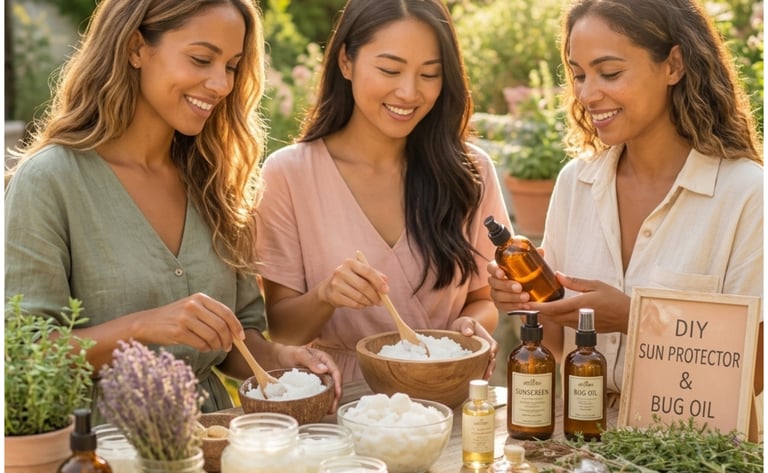
Summer is one of the best seasons for getting outside — long evenings, outdoor gatherings, time near the water. But for anyone who has started exploring natural living, green living, or plant-based skincare, it also brings a familiar dilemma. The two products most associated with outdoor protection — conventional sunscreen and DEET-based bug spray — are among the most chemically complex items in the average medicine cabinet.
The good news is that natural alternatives exist, they work, and you can make them yourself at home with a handful of clean, plant-based ingredients. Here we walk you through what the research actually says about conventional products, and shares two simple DIY recipes to get you started on a cleaner, greener summer routine.
What Is Actually in Conventional Sunscreen?
Most conventional sunscreens rely on chemical UV filters to absorb ultraviolet radiation and convert it to heat. The six most common are avobenzone, oxybenzone, octocrylene, homosalate, octisalate, and octinoxate. For decades these were assumed to sit harmlessly on the surface of the skin. Recent research tells a different story.
In 2019 and 2020, the FDA published two clinical studies in JAMA (the Journal of the American Medical Association) confirming that all six chemical UV filters absorb through the skin and into the bloodstream after just one use. Blood concentrations continued rising with every day of application and remained elevated up to seven days after stopping use. The FDA has not concluded these ingredients are unsafe — they stress that sun protection remains important — but they have formally requested more safety data from manufacturers because long-term effects at these absorption levels are not yet fully understood.
This is not fringe wellness content. This is peer-reviewed science published in one of the most respected medical journals in the world. And for people already committed to natural remedies and clean beauty, it is a reasonable reason to look for an alternative.
The Natural Alternative: Mineral Sunscreen with Zinc Oxide
Mineral sunscreens work completely differently from chemical ones. Instead of absorbing UV rays (and absorbing into your skin), they use physical mineral particles that sit on the surface of the skin and reflect and scatter ultraviolet radiation away. Think of it like a mirror rather than a sponge.
Non-nano zinc oxide is the gold standard mineral filter for natural skincare. It is the only sunscreen active ingredient the FDA has proposed to classify as Generally Recognized as Safe and Effective (GRASE). It provides broad-spectrum protection against both UVA and UVB rays, does not enter the bloodstream, and does not damage coral reefs — unlike oxybenzone, which has been shown in peer-reviewed studies to cause bleaching and deformities in coral at early life stages. Hawaii and the U.S. Virgin Islands have already banned oxybenzone sunscreens for this reason.
Choosing non-nano specifically matters. Nano-particle zinc oxide is small enough to potentially penetrate skin more deeply and be absorbed by aquatic organisms. Non-nano particles stay on the surface, making them the safer choice for both your body and the environment — a core principle of genuinely green living. Please be aware when buying a mineral sunscreen to look at the ingredients as many of them are not 100% natural - they simply contain a mineral.
Simple DIY Mineral Sunscreen Body Butter
First, you can simply add non-nano zinc oxide to your existing body butter, you just want to make sure it contains 20%, therefore 80g of butter to 20g of zinc. You can also make your own body butter then follow this same ratio. Here is a basic ratio for making body butter (for beginners):
Ingredients:
70% Plant butter like Shea or Mango butter
30% Plant oil like Safflower or Apricot
Important: Wear a dust mask when handling zinc oxide powder. Also, since this recipe cannot be tested for its SPF rating at home, use it as part of a complete sun protection strategy alongside protective clothing and shade. Its effectiveness depends on how thick you apply it, if the product was measured accurately, etc.
For a complete recipe with full mixing instructions, ingredient rationale, and customization tips, see our Sun Safe + Bug Free Guide.
What About DEET Bug Spray?
DEET (N,N-Diethyl-meta-toluamide) is effective. That is not in question. But for people interested in natural remedies and chemical-free living, a few things about DEET are worth knowing.
First, dermal absorption is well documented. DEET penetrates the skin and enters the bloodstream, and with excessive use — particularly in children — adverse neurological effects have been reported in rare cases. Second, DEET does not stay on your body. It washes off into waterways via showers and sweat, and a 2025 study published in ACS ES&T Water found DEET present in all tested environmental samples including surface water and sediment, with evidence of chronic effects on aquatic organisms with continued exposure.
For everyday short-term outdoor use — a backyard gathering, a hike, an evening walk — essential oils offer a genuinely natural alternative backed by real scientific study. For travel to regions with high risk of mosquito-borne illness such as malaria or dengue, consult your healthcare provider and do your own due diligence before relying solely on essential oil-based repellents.
Natural Bug Repellent Using Essential Oils: What the Research Shows
Not all essential oils are equal when it comes to repellency. The ones worth knowing about are the ones with actual peer-reviewed evidence behind them.
Litsea cubeba ranked among the highest for mosquito repellency in multiple peer-reviewed studies, including against Aedes aegypti, the mosquito responsible for dengue and Zika. Its repellent activity comes from citral, a naturally occurring compound that disrupts insect sensory receptors.
Rose geranium contains citronellol, a compound structurally similar to citronella and well-studied for its insect-repelling properties. It is gentle on skin and pleasant smelling, making it well-suited to a leave-on body oil. As a bonus it works well against ticks too, but it does not work 100% of the time, so still take other measures to protect yourself.
Lemon eucalyptus essential oil contains citronellal and related terpenoid compounds with documented repellent properties. Note: this is the essential oil, which differs from OLE (Oil of Lemon Eucalyptus), a processed extract that is the only plant-based repellent endorsed by the CDC.
Simple DIY Bug Repelling Body Oil
Ingredients:
Jojoba and Camellia and/or Apricot oil as your carrier base
1% Litsea Cubeba
2% Lemon Eucalyptus
2% Rose Geranium
⚠️ Important safety note: At 5% total essential oils, this blend is higher than the general recommendation of max 2% for a daily body oil application. It is formulated for occasional use when bug protection is needed — not for everyday application. Always patch test on your inner arm 24 hours before first use. If you have sensitive skin, reduce essential oil concentrations.
For full mixing instructions, dilution guidelines, patch testing guidance, and a children's safety note, see the Sun Safe + Bug Free Guide E-booklet
**The e-booklet also includes a spray version of this recipe
The Bigger Picture: Green Living, Homesteading, and What You Put on Your Skin
For anyone on a natural living or homesteading path, the principles are the same whether you are looking at what goes into your food or what goes onto your skin. Fewer synthetic chemicals. Greater transparency about sourcing. Less plastic waste. Ingredients you can trace back to the earth.
Making your own outdoor body care products checks every one of those boxes. You control the ingredients. You reuse your containers. You skip the synthetic preservatives, propellants, and mystery fragrances. And you end up with products that are genuinely vegan, genuinely plant-based, and genuinely natural — not just marketed that way.
The environmental argument is equally compelling. Conventional sunscreen chemicals wash off in the ocean every time a swimmer enters the water. Estimates suggest 6,000 tons of sunscreen enters U.S. reef areas annually. Non-nano zinc oxide is the reef-safe, biodegradable alternative. And replacing a plastic aerosol bug spray with a reusable glass bottle of carrier oil and essential oils is a small but real reduction in your plastic footprint.
Want to Go Deeper?
The two recipes above are a starting point. There is a lot more to understanding why specific butters and oils make a difference in your sunscreen, how to safely dilute essential oils, how to customize formulations for sensitive skin, how to make them less greasy feeling, and what the full research says about each ingredient.
The recipes in this post are real and they work on their own. The guide is for anyone who wants to understand the why behind every choice, safely customize for their skin type, or learn about the other three recipes in the collection: a cooling sunburn relief spray made from botanical hydrosols, and an after-bite roll-on designed to reduce inflammation and stop the itch fast, and a spray version of the bug oil (by popular demand)
Sun Safe + Bug Free: The Green & Frugal Guide to Natural Outdoor Skincare
Five complete recipes. Full ingredient science. Essential oil safety and dilution guidelines. Health and environmental research with sources. Customization tips for every skin type.
Available at greenandfrugalcreations.com
Tara Holguin is the founder of Green + Frugal Creations, a natural body care educator based in Toronto, Canada. She has spent over a decade researching plant-based skincare ingredients while formulating truly natural products for Green + Frugal body care shops and helping people make informed choices about what goes on their bodies.
greenandfrugalcreations.com | @greenandfrugal